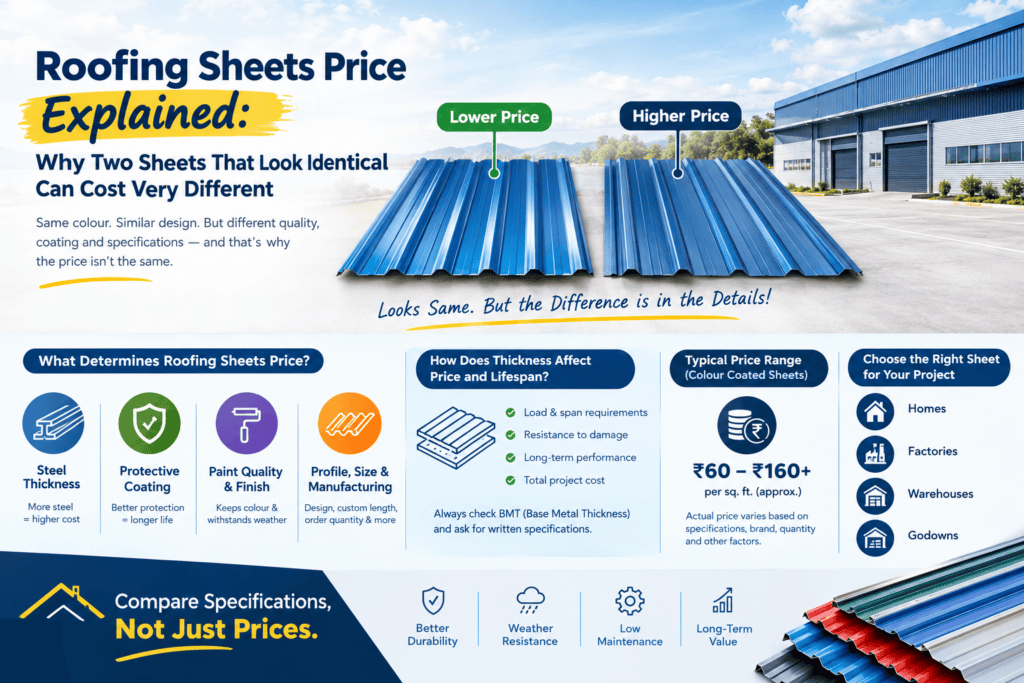
Two roofing sheets. The same colour. Almost the same design. Similar shine. Yet one quotation is significantly cheaper than the other.
So, what are you actually paying for?
When comparing roofing sheets price, appearance can be misleading. The real difference often lies in the steel thickness, protective coating, paint quality, manufacturing specifications, and suitability for your building. Choosing the cheapest option without checking these details may save money today but lead to higher maintenance and replacement costs later.
Whether you are constructing a home, setting up a factory, covering a warehouse, or building a godown, understanding these differences can help you make a smarter investment.
At Taj Roofing, the goal is to help buyers look beyond the price tag and understand what makes a roofing solution suitable for their project.
1. What Determines Roofing Sheets Price?
Roofing sheets are not priced on colour or appearance alone. Several technical and practical factors influence the final quotation.
Steel thickness
Thickness is one of the most important factors affecting the cost and performance of a roofing sheet. A thicker sheet generally contains more steel per square metre, which increases its material cost.
However, always check whether the quoted thickness refers to Base Metal Thickness (BMT) or Total Coated Thickness (TCT). BMT measures the steel substrate before coatings are added, while TCT includes the coating layers. Comparing one supplier’s BMT with another supplier’s TCT can lead to an inaccurate price comparison.
Protective coating
Steel roofing sheets require protective coatings to resist corrosion. The coating type and amount can significantly affect durability, especially in areas exposed to heavy rainfall, humidity, and prolonged moisture.
A sheet with a more suitable protective coating may cost more initially but could offer better long-term value.
Paint quality and finish
Colour-coated roofing sheets combine protective metal coatings with factory-applied paint. The paint system affects colour retention, weather resistance, and overall appearance.
Two sheets in the same shade may use different paint systems, so their prices and long-term performance may differ.
Profile, size and manufacturing
Corrugated, trapezoidal, and tile-profile sheets have different shapes and applications. Custom lengths, special finishes, order quantities, transportation, and installation requirements can also affect the overall cost.
The key takeaway? Compare specifications before comparing prices.
2. How Does Roofing Sheet Thickness Affect Price and Lifespan?
Thickness influences strength, resistance to deformation, and suitability for different roof spans. But thicker does not automatically mean better for every project. The correct specification depends on the structural design, purlin spacing, wind exposure, and intended use.
For example, a small residential roof and a large industrial shed may require very different specifications.
When evaluating roofing sheet thickness, consider:
- Load and span requirements: Larger spans and demanding site conditions may require stronger sheets and an appropriately designed support structure.
- Resistance to damage: Sheets with suitable thickness are generally better equipped to resist denting and deformation.
- Long-term performance: The right thickness, combined with suitable coatings and correct installation, can help reduce premature damage.
- Total project cost: Selecting a sheet that is too thin for the application may create avoidable maintenance or replacement expenses.
Ask the supplier to specify BMT clearly and provide the relevant product specifications. Avoid choosing a sheet based only on a verbal assurance that it is “heavy gauge” or “extra strong.”
3. What Is the Typical Colour Coated Roofing Sheets Price Per Sq. Ft.?
The colour coated roofing sheets price varies according to thickness, steel substrate, coating system, paint finish, profile, brand, and order quantity.
As a broad budgeting guide, colour-coated steel roofing sheets in India may cost approximately ₹60–₹160 or more per sq. ft. This is an indicative market range, not a fixed quotation. Some basic products may be available below it, while premium specifications can exceed it. Published price guides show substantial variation between products and suppliers.
Before using this estimate to prepare your budget, confirm whether the quotation covers only the sheets or includes other expenses.
Your actual project budget may also need to account for:
- Roofing structure and supporting members
- Screws, fasteners and sealing accessories
- Ridge caps, flashing and gutters
- Transportation and unloading
- Installation labour
- GST and other applicable charges
For a more accurate comparison, request a written quotation based on the same thickness, coating specification, profile, and quantity from every supplier.
4. Roofing Sheet Types: Which Is Best for Homes, Factories and Godowns?
Not every roofing material suits every building. The best option balances cost, durability, appearance, environmental exposure, and the building’s functional requirements.
Colour-coated steel roofing sheets
These sheets offer a combination of appearance and weather protection, making them suitable for many residential, commercial, and industrial projects.
They are worth considering when aesthetics matter alongside practical performance. However, compare the underlying steel, coating system, and paint specification rather than choosing based on colour alone.
Galvanised iron (GI) sheets
GI sheets have a zinc coating that helps protect steel against corrosion. They can be suitable for sheds, agricultural buildings, and other applications where a straightforward roofing solution is needed.
The actual performance depends on sheet thickness, coating quality, exposure conditions, and installation.
Galvalume and related coated steel sheets
These sheets use an aluminium-zinc alloy coating designed to provide corrosion resistance. They may be appropriate for projects where weather exposure and long-term durability are important considerations.
Check the specific coating specification and confirm that it suits your location and building requirements.
Insulated roofing panels
Insulated panels can be useful for temperature-sensitive spaces, including certain factories, cold-storage facilities, and specialised commercial buildings.
Although their upfront price can be higher, they serve a different purpose from conventional single-layer sheets. Compare thermal performance and the total building requirements, not just the cost per square foot.
Which should you choose?
- Homes: Consider colour-coated sheets where appearance, weather resistance, and maintenance requirements align with your needs.
- Factories: Evaluate structural requirements, roof span, corrosion exposure, and any thermal or operational demands.
- Godowns and warehouses: Prioritise suitable strength, dependable weather protection, and an economical whole-project cost.
A roofing professional can help match the material and profile to your building instead of recommending the same product for every application.
5. Five Ways to Avoid Overpaying for Roofing Sheets
A lower quotation is not always a better deal. Use these checks before placing an order.
- Compare identical specifications. Ask every supplier to quote the same BMT, coating type, paint system, profile, and sheet length.
- Check the coverage width. The overall width of a sheet is not necessarily the width it covers after overlapping with the next sheet. Compare the effective coverage area, not just the sheet dimensions.
- Request a complete cost breakdown. Clarify whether the price includes transportation, accessories, taxes, and installation. A low material price can become less attractive when additional costs are included.
- Ask about product documentation and warranty. Check available technical specifications, coating details, applicable standards, and warranty conditions. Understand what the warranty covers and what exclusions apply.
- Calculate the long-term value. Consider durability, maintenance, installation quality, and expected service requirements. A suitable, well-installed product can offer better value than a cheaper sheet that is poorly matched to the application.
These checks can help you identify genuine savings without compromising essential performance.
6. Where Can You Buy Roofing Sheets Directly from a Manufacturer?
If you want to buy roofing sheets confidently, start by identifying suppliers who can clearly explain their product specifications, available profiles, quality documentation, and delivery terms.
Buying directly from a manufacturer, where available, may provide clearer product information and pricing. However, the best purchasing route depends on your project size, location, transportation costs, and the supplier’s capabilities.
Before finalising your order, ask:
- Which thickness and coating specifications are available?
- Can the sheets be supplied in the required lengths?
- What is the effective coverage width?
- Are technical specifications and warranty details available?
- What is the total delivered cost for my project?
- Are compatible roofing accessories available?
For your roofing requirements, connect with Taj Roofing to discuss suitable roofing options for your home, factory, commercial building, or godown. Share your approximate roof area, building type, and location to help narrow down the right specifications and request a project-specific quotation.
Frequently Asked Questions
1. How does roofing sheet thickness affect price and lifespan?
Thicker sheets generally cost more because they contain more steel and may provide greater resistance to deformation. However, lifespan also depends on protective coatings, environmental exposure, installation, and maintenance. Taj Roofing can help you evaluate the specifications appropriate for your project.
2. What is the typical colour coated roofing sheets price per sq. ft.?
An indicative budgeting range is around ₹60–₹160 or more per sq. ft. in India, depending on product specifications and market conditions. The actual quotation may differ, and installation, accessories, transportation, and taxes may be additional. Contact Taj Roofing for pricing based on your requirements.
3. Which roofing sheet types are best for homes, factories and godowns?
Colour-coated steel sheets are a versatile option for many building types, while GI, Galvalume, and insulated panels may suit particular budgets and functional needs. The right choice depends on structural design, weather exposure, and intended use. Taj Roofing can help you assess the available options for your building.
4. Where can I buy roofing sheets directly from a manufacturer?
Contact manufacturers or authorised suppliers and verify their specifications, warranty terms, delivery costs, and product availability. For your project, reach out to Taj Roofing to discuss suitable roofing solutions and request a detailed quotation.
Conclusion: Look Beyond the Price Tag
Two roofing sheets can look almost identical and still deliver different levels of strength, corrosion resistance, and long-term performance. The difference often comes down to specifications that are difficult to judge by appearance alone.
Before making a purchase, compare the steel thickness, coating, paint finish, effective coverage, and total delivered cost. Most importantly, choose roofing sheets that match your building’s requirements rather than paying for unnecessary features—or compromising on essential ones.
Planning a roofing project? Get in touch with Taj Roofing to explore suitable roofing options, understand the specifications, and request a quotation tailored to your project. Make your next roofing decision with clarity, confidence, and long-term value in mind.