Imagine opening your electricity bill and seeing a much smaller amount than usual. Instead of worrying about running your air conditioner, refrigerator, washing machine, or other household appliances, you know that your rooftop solar system is generating electricity right above your home.
For many Indian households, this is one of the biggest attractions of solar energy. And with the PM Surya Ghar Yojana, installing rooftop solar has become more affordable through government subsidies.
But how much money can you actually save? Does Assam offer a higher solar subsidy than other states? How much will solar panel installation cost after the subsidy? And what should you do to make sure you qualify?
If you are considering rooftop solar in Guwahati or elsewhere in Assam, this guide explains the scheme, the subsidy amounts, the application process, and the factors that affect your final investment.
What Is PM Surya Ghar Yojana?
The PM Surya Ghar: Muft Bijli Yojana is a Government of India initiative launched in February 2024 to encourage households to install grid-connected rooftop solar systems.
The scheme aims to support rooftop solar installations in one crore households across India. Eligible residential consumers can receive Central Financial Assistance (CFA) to reduce the upfront cost of installing solar panels.
The idea is straightforward: generate electricity on your own rooftop, use it to meet household requirements, and reduce your dependence on electricity purchased from the grid.
For eligible households, the scheme can make solar panel installation significantly more affordable.
However, it is important to understand that the subsidy does not automatically make electricity completely free. Your actual savings depend on the solar system’s generation, household consumption, electricity tariffs, and applicable metering arrangements.
How Much Solar Subsidy Can You Get in 2026?
The amount of rooftop solar subsidy depends on the system capacity and the category of state in which the household is located.
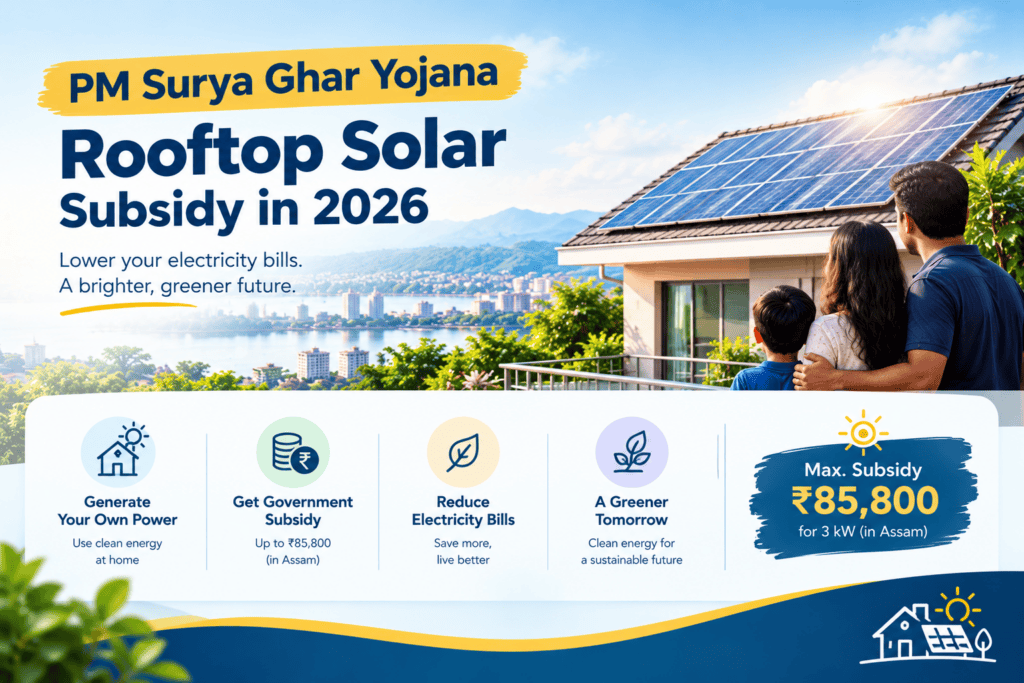
Under the published scheme rates, residential consumers in general states can receive up to ₹78,000 for a system of 3 kW or more. Eligible households in special-category states, including Assam, can receive up to ₹85,800.
Here is a breakdown of the central subsidy amounts.
| Rooftop Solar Capacity | General States | Special-Category States, Including Assam |
| 1 kW | ₹30,000 | ₹33,000 |
| 2 kW | ₹60,000 | ₹66,000 |
| 3 kW | ₹78,000 | ₹85,800 |
| Above 3 kW | Maximum ₹78,000 | Maximum ₹85,800 |
These are the published central subsidy rates for eligible residential systems. Confirm the applicable amount and current scheme conditions on the official portal before installation.
Notice something important: the central subsidy is capped at 3 kW. If you install a 5 kW or 10 kW system, you do not automatically receive a higher central subsidy than the applicable 3 kW maximum.
Your system capacity should therefore be selected according to your electricity consumption, available roof space, budget, and future requirements—not just the subsidy amount.
What Is the Maximum Solar Subsidy Available for a 3 kW System in 2026?
For eligible households, the maximum published central subsidy for a 3 kW rooftop solar system is:
- ₹78,000 in general states
- ₹85,800 in eligible special-category states, including Assam
This makes a 3 kW system an important option for households that want to reduce electricity expenses while taking advantage of the available central assistance.
However, 3 kW is not necessarily the right system size for every home.
For example, a household with relatively low electricity consumption may find a smaller system more appropriate. A household that regularly operates multiple air conditioners or other high-consumption appliances may need a larger installation.
Before deciding, review your recent electricity bills and discuss the appropriate system size with a qualified solar installer.
Is Rooftop Solar Subsidy Higher in Assam Than in the Rest of India?
Yes. Under the published PM Surya Ghar central subsidy structure, eligible residential consumers in Assam fall under the special-category state rates, which are higher than the rates applicable in general states.
This is particularly relevant for homeowners in Guwahati and other parts of Assam who are considering rooftop solar.
For a 3 kW installation, the published central assistance can reach ₹85,800, compared with ₹78,000 in general states.
That difference can reduce the upfront investment for an eligible household.
However, the subsidy is not the only factor that determines whether solar makes financial sense. Roof orientation, shading, installation quality, household consumption, system performance, and maintenance requirements also influence the overall benefit.
A professional assessment can help you understand how much electricity your roof can realistically generate and which system size is appropriate.
How Much Does Solar Panel Installation Cost After the Government Subsidy?
This is where many homeowners need to look beyond the headline subsidy amount.
The final cost of solar panel installation depends on several factors, including:
- System capacity
- Solar panel type and specifications
- Inverter quality and capacity
- Mounting structure
- Electrical components and protection systems
- Installation complexity
- Wiring and other site requirements
- Applicable metering or administrative charges
- Whether battery storage is included
The government subsidy reduces the eligible system cost, but it does not mean that every installation will have the same final price.
An Example: Calculating the Cost of a 3 kW System in Assam
Suppose a homeowner receives a quotation of ₹1,80,000 for an eligible 3 kW rooftop solar installation.
The calculation would look like this:
| Cost Component | Amount |
| Illustrative installation quotation | ₹1,80,000 |
| Applicable central subsidy | ₹85,800 |
| Illustrative amount remaining after subsidy | ₹94,200 |
This is an example for understanding the calculation, not an official market price or a quotation from Taj Solar. Actual installation costs can vary, and you should confirm which components, taxes, metering charges, and other expenses are included in your quotation.
The important point is that the subsidy can substantially reduce your initial investment, but you still need to budget for the remaining amount.
When comparing quotations, check the complete system specifications rather than choosing a provider solely because it offers the lowest price.
How Does Solar Panel Installation Affect Eligibility for PM Surya Ghar Yojana?
Getting the installation process right is essential if you want to claim the subsidy.
Buying solar panels and installing them independently does not automatically make you eligible for the scheme. The installation must follow the applicable programme requirements.
Here is the general process for eligible residential consumers.
Step 1: Register on the Official Portal
Visit the official PM Surya Ghar portal at https://pmsuryaghar.gov.in.
Register using the required details, including your state, electricity distribution company, and consumer information.
Step 2: Submit Your Application
Complete the application process and follow the requirements applicable to your electricity connection and proposed system.
For consumers in Assam, the relevant electricity distribution company is Assam Power Distribution Company Limited (APDCL).
Step 3: Select an Eligible Registered Vendor
Choose a vendor registered for the scheme in your area through the official portal.
Before proceeding, discuss system capacity, panel specifications, inverter selection, installation requirements, warranty coverage, and the complete cost.
Step 4: Complete the Installation
The rooftop solar system must be installed in accordance with the applicable scheme and technical requirements.
Avoid assuming that an installation completed outside the required process will qualify for the central subsidy.
Step 5: Complete Metering and Commissioning Requirements
After installation, follow the applicable procedures for system details, net metering, inspection, and commissioning.
The system must meet the relevant requirements before the subsidy claim can be processed.
Step 6: Submit the Required Bank Details
Complete the subsidy claim process through the official portal and provide the required banking information.
The subsidy is transferred according to the scheme’s applicable procedures once the necessary requirements are fulfilled.
Practical tip: Before paying an advance, verify your eligibility and confirm the required application sequence with the registered vendor. This can help you avoid preventable delays or problems with your subsidy claim.
Will PM Surya Ghar Make Your Electricity Bill Zero?
The scheme is widely associated with the promise of up to 300 units of free electricity per month, but the actual benefit depends on the household’s solar generation and electricity consumption.
A properly sized rooftop solar system can reduce the amount of electricity purchased from the grid. However, generation varies according to weather, shading, roof orientation, system performance, and seasonal conditions.
Your final electricity bill also depends on the applicable tariff, fixed charges, metering arrangements, and other charges that may remain payable.
For example, a household that consumes more electricity than its solar system generates may still need to purchase additional power from the grid.
Similarly, a home that uses most of its electricity after sunset may need to consider how its solar generation aligns with its consumption and whether a battery is appropriate.
The best approach is to assess your electricity bills and expected generation before making financial projections. Do not assume that every household will receive a zero bill every month.
Is Rooftop Solar Worth It for Homes in Guwahati and Assam?
For many homeowners, rooftop solar can be a practical way to reduce long-term electricity expenses, particularly when the roof receives sufficient sunlight and the system is properly designed.
In Guwahati and other parts of Assam, however, the installation should account for local weather conditions.
Before installing a system, consider:
Roof suitability: The roof should have sufficient usable space and be structurally suitable for the installation.
Rainfall and waterproofing: Mounting structures, cable routes, and roof penetrations should be handled carefully to reduce the risk of water leakage.
Shading: Trees, neighbouring buildings, and other obstructions can affect electricity generation.
Electrical safety: Proper wiring, earthing, protection devices, and installation practices are essential.
Maintenance: Solar panels require periodic inspection and cleaning as appropriate to the local environment.
System sizing: The installation should match your household’s electricity requirements rather than simply maximising panel capacity.
A well-planned installation can help you make better use of the subsidy and improve the long-term value of your investment.
Why Choose Taj Solar for Your Rooftop Solar Journey?
Understanding the subsidy is only the first step. The next is choosing the right solar solution for your home.
At Taj Solar, the focus is on helping homeowners understand their rooftop solar options and make informed decisions about system capacity, installation requirements, and the potential benefits of switching to solar energy.
Whether you are exploring a 1 kW system for basic household requirements or considering a larger installation, the right starting point is a proper assessment of your electricity consumption, roof suitability, and budget.
Before committing to an installation, discuss:
- The appropriate system capacity for your home.
- The specifications of the proposed solar panels and inverter.
- The complete installation quotation.
- The applicable PM Surya Ghar subsidy and eligibility requirements.
- The expected electricity generation.
- Warranty, maintenance, and after-installation support.
For eligible households in Assam, understanding the applicable subsidy rate is especially important because the published special-category rate can reduce the upfront cost.
Taj Solar can help you explore your rooftop solar requirements and understand the factors involved in planning an installation. Confirm the vendor’s current scheme registration and eligibility for subsidy-linked installations before proceeding.
Frequently Asked Questions
1. What is the maximum solar subsidy available for a 3 kW system in 2026?
Under the published PM Surya Ghar subsidy rates, eligible households can receive up to ₹78,000 in general states and ₹85,800 in eligible special-category states such as Assam. The subsidy is capped at 3 kW. Check the official portal for current eligibility and requirements.
2. Is rooftop solar subsidy higher in hilly states like Assam compared to the rest of India?
Assam receives the higher special-category central subsidy rate under the published scheme structure. Eligible households can receive up to ₹85,800 for a 3 kW system, compared with ₹78,000 in general states. Eligibility and applicable rates should be verified before installation.
3. How does solar panel installation affect eligibility for the PM Surya Ghar scheme?
The installation must follow the scheme’s application, vendor, technical, metering, and commissioning requirements. Eligible residential consumers should register through the official portal and follow the prescribed process before proceeding with installation. Taj Solar recommends confirming eligibility and vendor registration before committing to a subsidy-linked project.
4. How much does a solar panel cost come down after the government subsidy is applied?
The final amount depends on the installation quotation and the subsidy for which the household qualifies. For example, a hypothetical ₹1,80,000 installation in Assam would cost ₹94,200 after an ₹85,800 subsidy, assuming the full subsidy is approved and the quotation represents the relevant total cost. Actual prices and additional charges vary.
5. Does PM Surya Ghar provide subsidies for systems larger than 3 kW?
The central residential subsidy is capped at 3 kW under the published scheme rates. Eligible households may install a larger system based on their requirements, but they should not expect additional central subsidy beyond the applicable maximum.
6. Can I install rooftop solar first and apply for the subsidy later?
Do not assume that a completed installation will automatically qualify. Follow the official portal’s application sequence and applicable scheme requirements, and confirm the process with an eligible registered vendor before installation.
Final Thoughts
The PM Surya Ghar Yojana has made rooftop solar more accessible by reducing the upfront cost for eligible households.
For homeowners in Assam, the published central subsidy can reach ₹85,800 for a qualifying 3 kW residential system. That can make a meaningful difference to the initial investment, although the final cost and long-term savings depend on the installation quotation, electricity consumption, system performance, and applicable charges.
The smartest way to approach solar is to understand the subsidy first, assess your roof and electricity needs, compare complete installation quotations, and follow the official application process.
If you are planning to switch to rooftop solar, Taj Solar can help you explore suitable system options and take the next step towards a more energy-efficient home.